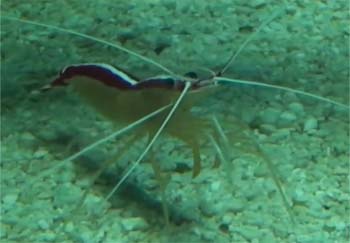
Cleaner ShrimpFacts - Information - Picture - Video Profile of the Cleaner Shrimp
This Profile contains interesting facts and information about the Cleaner Shrimp species. Diet / Feeding: Parasites and dead tissue Temperament: Good addition to a community tank, they will clean the tank and the fish! Habitat: Reef dwellers, marine waters Behaviour: Symbiotic relationship with fish, removes their parasites
Scientific Classification of the Cleaner Shrimp
Definition: Scientific classification, or biological classification, is how biologists group and categorize species of organisms with shared physical characteristics. Scientific classification belongs to the science of taxonomy. Interesting Facts and Information - How do you identify the sex of a Cleaner Shrimp?
The males and females of many fish species have different colors or different shaped bodies. But there are also other fish species where there is no visible difference. Its sometimes tricky being an ichthyologist!
Interesting Facts and Information - Why do Cleaner Shrimp have gills?
Gills enable the Cleaner Shrimp to breathe. Gills consist of thin sheets of tissue containing blood vessels. As water passes over the gills oxygen is absorbed into the blood stream Carbon dioxide passes out into the water. The gills are protected by a large bony plate called an operculum. Some fish species however have lungs and breathe air.
Interesting Facts and Information - Why is the Cleaner Shrimp called an Arthropod?
An Arthropod is an invertebrate animal (without a backbone) that has a segmented body with jointed limbs (appendages). True crabs are Decapod Crustaceans. Some species such as Hermit crabs, Porcelain crabs King crabs and Horseshoe crabs are not true crabs! Decapod Crustaceans have five pairs of legs, the first three are used for feeding. At the end of the limbs are the chelae which is the correct term for pincers or claws.Interesting Facts and Information about Cleaner Shrimp
|