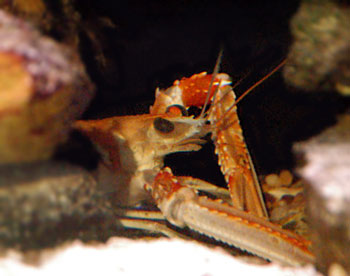
Dublin Bay PrawnFacts - Information - Picture Profile of the Dublin Bay Prawn
This Profile contains interesting facts and information about the Dublin Bay Prawn species. Size: Up to 20cm Fish Tank conditions: PH 8.0 to 8.4 Diet / Feeding: Crustaceans and Worms Temperament: Territorial and Predatory Habitat: Bottom Dwellers at depths of up to 800m Range: North Eastern Atlantic Ocean, North Sea, Mediterranean Sea
Scientific Classification of the Dublin Bay Prawn
Definition: Scientific classification, or biological classification, is how biologists group and categorize species of organisms with shared physical characteristics. Scientific classification belongs to the science of taxonomy. Interesting Facts and Information - How do you identify the sex of a Dublin Bay Prawn?
The males and females of many fish species have different colors or different shaped bodies. But there are also other fish species where there is no visible difference. Its sometimes tricky being an ichthyologist!
Interesting Facts and Information - Why is the Dublin Bay Prawn called an Arthropod?
An Arthropod is an invertebrate animal (without a backbone) that has a segmented body with jointed limbs (appendages). Prawns have ten walking legs; the front three pairs have claws, the first of which are larger than the others. The legs of the prawn are divided into seven segments. These are: Coxa, Dactylus, Basis, Carpus, Ischium, Merus and Propodus. The limbs are biramous which means that they branch into two and subsequent sections are then joined end to end. At the end of the limbs are the chelae which is the correct term for pincers or claws.Interesting Facts and Information - Why do Dublin Bay Prawn have gills?
Gills enable the Dublin Bay Prawn to breathe. Gills consist of thin sheets of tissue containing blood vessels. As water passes over the gills oxygen is absorbed into the blood stream Carbon dioxide passes out into the water. The gills are protected by a large bony plate called an operculum. Some fish species however have lungs and breathe air.
Interesting Facts and Information - Why do Dublin Bay Prawn have an Exoskeleton?
A prawns shell is an exoskeleton. An exoskeleton protects the crustacean from predators and is also used for sensing and feeding. The exoskeleton grows and hardens and is eventually shred when the carpace becomes too small. The carpace is the upper section of the exoskeleton. Interesting Facts and Information about Dublin Bay Prawn
|