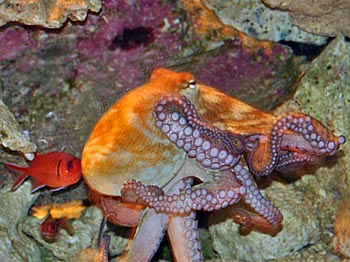
OctopusFacts - Information - Picture Profile of the Octopus
This Profile contains interesting facts and information about the Octopus species. Size: Its body (mantle) can be up to 27cm, its arms can span up to 1m Diet / Feeding: Crabs, Crayfish, will eat almost anything! Temperament: Very Intelligent Habitat: Tropical Marine Waters up to 200m in depth Range: Eastern Atlantic, Mediterranean Sea
Scientific Classification of the Octopus
Definition: Scientific classification, or biological classification, is how biologists group and categorize species of organisms with shared physical characteristics. Scientific classification belongs to the science of taxonomy. Interesting Facts and Information - How do you identify the sex of a Octopus?
The males and females of many fish species have different colors or different shaped bodies. But there are also other fish species where there is no visible difference. Its sometimes tricky being an ichthyologist!
Interesting Facts and Information - Octopus
Octopuses have two eyes and four pairs of arms. They don't have an internal or external skeleton and as such they are able to squeeze through the smallest spaces. They secrete a type of mucus, or slime, which they use to paralyse their prey.
Interesting Facts and Information - Why do Octopus have gills?
Gills enable the Octopus to breathe. Gills consist of thin sheets of tissue containing blood vessels. As water passes over the gills oxygen is absorbed into the blood stream Carbon dioxide passes out into the water. The gills are protected by a large bony plate called an operculum. Some fish species however have lungs and breathe air.Interesting Facts and Information about Octopus
|